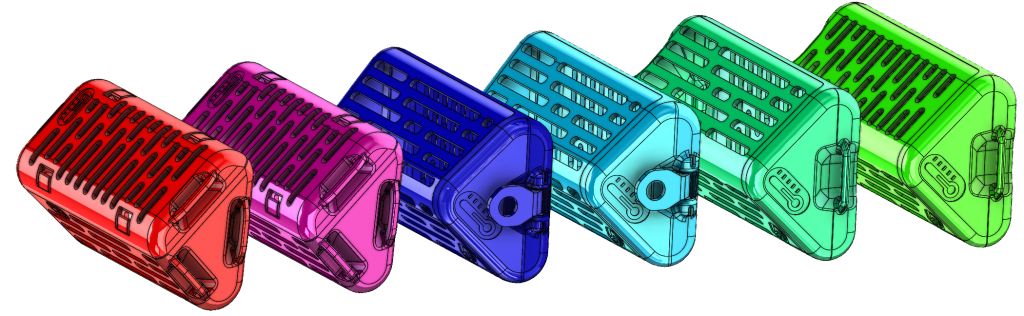
In a traditional manufacturing setting, a single CAD change, like thickening a wall or shifting a bolt hole, triggers a cascade of tooling delays and stalled production schedules.
Additive manufacturing replaces fixed tooling with a digital thread, shrinking the journey from a CAD revision to a finished component from months to days. However, achieving industrial precision requires a structured, engineering-first workflow. Here is how a design transitions from a screen modification to a high-performance physical part.
1. The Engineering Review & DfAM Optimization
The process begins the moment a revised STEP file is received. Instead of relying on automated software, industrial-grade production requires a human-in-the-loop Design for Additive Manufacturing (DfAM) assessment to evaluate geometric changes against the physics of the build chamber:
- Orientation Optimization: Aligning the part to ensure real-world load paths do not cross vulnerable, anisotropic Z-axis layer lines.
- Thermal Management: Analyzing geometry to ensure thickened sections won’t trap heat during cooling, preventing warping in high-performance materials like HP MJF Nylon.
2. Digital Slicing and Toolpath Generation
Once optimized, the CAD model is translated into thousands of microscopic, two-dimensional layers. For processes like HP Multi Jet Fusion (MJF), this stage leverages algorithmic Design Nesting. Packing the revised part alongside other geometries in a single 3D build volume maximizes machine throughput and directly slashes per-unit costs by spreading fixed operational overhead.
3. The Physical Build Phase
The printer constructs the part layer-by-layer, bonding powder or extruding super-polymers based on the sliced CAD data. Throughout the build, real-time sensors and closed-loop monitoring track thermal consistency across the print bed, ensuring the mechanical properties of the raw material meet strict performance baselines.
4. Professional Finishing: Tronix3D Post-Processing
A raw print is just a “near-net shape.” To transition it into a flight-ready component, Tronix3D integrates a suite of in-house post-processing and finishing services to achieve precise engineering tolerances:
- Automated Vibratory Tumbling: Uses mechanical media to uniformly reduce surface roughness, improving both aesthetics and fatigue life across complex geometries.
- Vapor Smoothing: A chemical refinement process that fully seals the surface of polymers like PA12. This is critical for fluidic manifolds, airtight components, or achieving an injection-molded surface finish.
- Advanced Coatings: Industrial dyeing, specialized Cerakote coatings, and metal plating provide environmental resistance, UV protection, and enhanced surface hardness.
- Mechanical Integration: Pressing in threaded inserts, part assembly, and secondary CNC machining on critical mating faces for micrometer-perfect tolerances.
The Competitive Advantage
If field testing demands another structural adjustment, the cycle resets instantly. There are no molds to scrap and no supply chain bottlenecks. You simply update the CAD file, upload the new digital thread, and print the next iteration.
To accelerate your development cycles and eliminate the friction between design revisions and finished hardware, connect with our engineering team to start a technical design review at tronix3d.com.