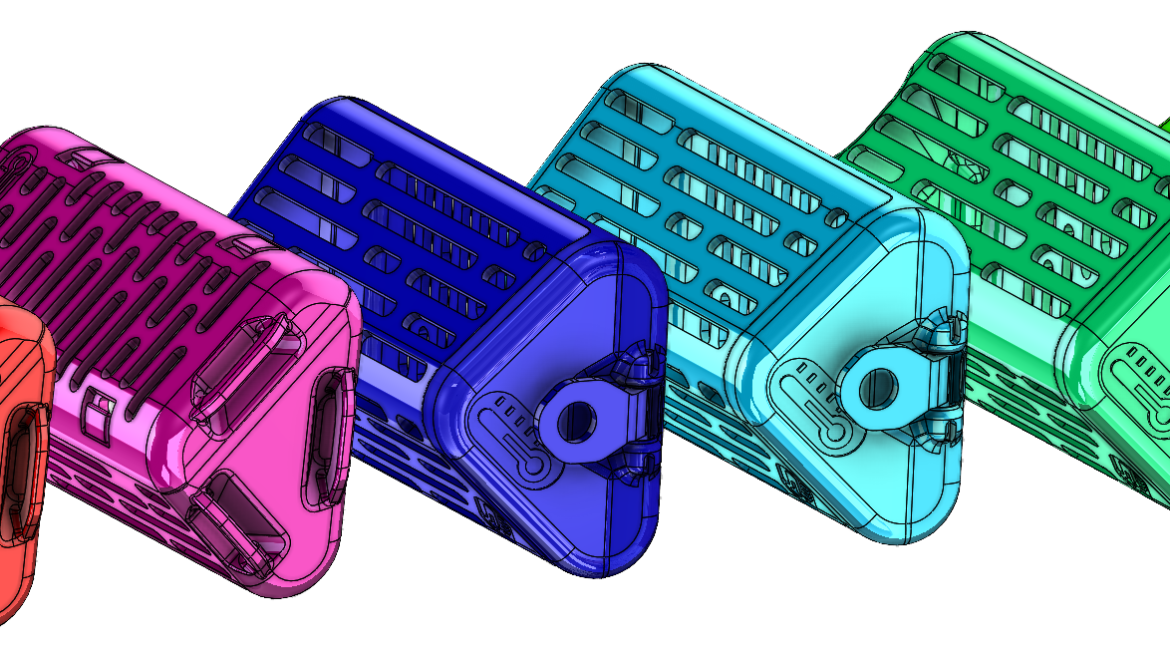
In the 2026 drone market, agility is a competitive necessity. Whether you’re developing defense loitering munitions or commercial VTOLs, traditional manufacturing cycles are too slow. Here’s why rapid iteration is the primary advantage in UAV development. The End of the 6-Month Lead Time Domestic sourcing for drone components often takes…
In government contracting and industrial manufacturing, transparency is just as important as technical skill. At Tronix3D, we maintain a specific set of federal registrations and certifications that allow us to move at the speed of innovation while meeting strict agency requirements. If you’ve seen the string of codes in our…
For years, engineers were trapped: pay a premium for 3D-printed prototypes or invest heavily in hard tooling for injection molding. By leveraging industrial-scale additive manufacturing, we make low to mid-volume production (50–5,000+ parts) cost-competitive with traditional methods. Here is how our engineering process drives down your per-unit costs. High-Density Design…
In the aerospace, defense, and robotics sectors, “time to market” is a primary competitive advantage. Whether you are replacing a legacy part for a grounded aircraft or iterating on a new robotic actuator, project speed often hinges on the speed of your quote. At Tronix3D, we have optimized our workflow…
For a long time, the engineering decision-making process was straightforward: if a part faced mission-critical loads or extreme temperatures, you reached for aluminum or titanium. It was the safe bet, backed by decades of heritage data. However, that traditional “metal-first” mindset is now often becoming a liability. At Tronix3D, we…
Every engineer has experienced the frustration: a CAD model looks flawless on screen, but the physical part arrives warped, brittle, or filled with trapped supports. The reality is that a digital model represents only about 80% of a successful part. The “Hidden 20%” lies in the nuances of the manufacturing…
For decades, titanium has been the “holy grail” of industrial materials. Known for its incredible strength-to-weight ratio, corrosion resistance, and biocompatibility, titanium (specifically the Ti6Al4V alloy) is the gold standard for aerospace, defense, and medical applications. However, until recently, producing titanium parts via additive manufacturing was a luxury reserved for…
For nearly a century, the backbone of industrial logistics has been built on a single, expensive word: Stock. In 2026, the traditional model of manufacturing—producing thousands of identical parts in a centralized factory and shipping them to regional warehouses—is reaching a breaking point. The global supply chain shocks of the…
We’ve all been there: a brilliant product idea hits you while you’re at a coffee shop. You grab a napkin, scribble a rough sketch, and think, “I wish I could see what this looks like in 3D.” Historically, that next step required hours—if not days—of CAD modeling and rendering. But…
For over a decade, the additive manufacturing industry has leaned on a singular, powerful promise: the democratization of production. The vision was clear—a world where the ability to create physical objects would shift from massive, centralized factories to the agile, local desktop. However, as we enter 2026, we have to…