High-performance thermoplastics like PEEK, PEKK, and ULTEM 9085 have transformed modern manufacturing. Offering exceptional strength-to-weight ratios, chemical resistance, and thermal stability, these super polymers serve as primary metal-replacement candidates in aerospace, energy, and electronics applications.
However, processing these materials requires extreme thermal control. High glass transition temperatures and steep thermal gradients often cause warping, layer delamination, and internal stress concentrations.
Traditionally, engineers resolved thermal issues through expensive trial and error, adjusting orientations, chamber temperatures, and infill patterns across multiple failed builds. Predictive toolpathing powered by machine learning eliminates that wasted machine time and raw material cost. By integrating neural networks into the slicing phase, manufacturing teams predict thermal behavior and material deformation before initiating prints on high-temperature FDM systems.
The Thermal Challenge of Super Polymers
Processing super polymers requires nozzle temperatures near 500°C and build chambers heated up to 180°C. As the print head deposits molten filament, uneven cooling across complex geometries generates residual internal stresses.
In aerospace brackets or sealed electronic enclosures, unmanaged thermal stress leads to dimensional distortion or micro-cracks along the Z-axis. Standard slicing software applies a uniform shrinkage percentage across the entire bounding box. In practice, thermal expansion and layer shrinkage are dynamic variables dictated by localized wall thickness, toolpath vector lengths, and volumetric cooling rates.
How Machine Learning Transforms Toolpath Generation
Predictive slicing software uses trained neural networks to run high-speed thermal and mechanical simulations during CAD translation. The software analyzes part geometry voxel by voxel:
Predictive Thermal Mapping: Neural networks simulate layer-by-layer thermal dissipation, identifying localized heat traps before printing begins.
Dynamic Toolpath Optimization: The slicer adjusts print speeds, extrusion rates, and toolpath vectors dynamically, preventing thermal stress vectors from aligning.
Stress-Informed Compensation: The system selectively offsets part boundaries to compensate for non-uniform thermal shrinkage, ensuring parts cool into their specified tolerances.
Applications in Aerospace, Energy, and Electronics
Predictive toolpathing unlocks high repeatability and geometric fidelity for critical applications:
Aerospace: ULTEM 9085 structural ducts and high-altitude enclosures retain strict mounting tolerances without post-process machining.
Energy: Carbon-fiber PEEK downhole components maintain structural integrity under high pressure by preventing internal micro-voids.
Electronics: High-temperature sensor housings achieve precise snap-fits and flat, warp-free mating surfaces on the first build cycle.
First-Time-Right Super Polymer Production
Integrating machine learning into additive manufacturing shifts high-performance FDM into a repeatable production process. Predicting material physics before printing reduces raw material waste, eliminates failed build cycles, and delivers mission-critical parts faster.
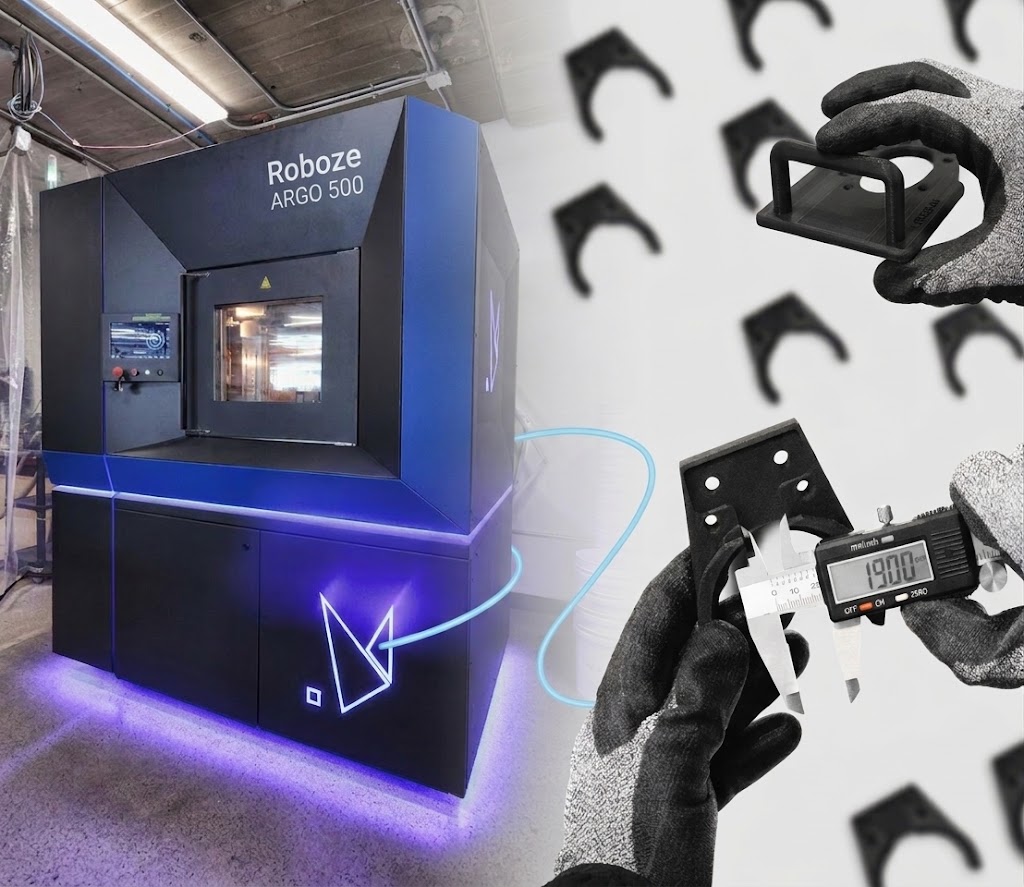
At Tronix3D, we pair high-performance FDM platforms like the Roboze Argo 500 with deep engineering expertise to deliver end-use components for harsh environments. To evaluate your high-temperature polymer application or optimize your designs, talk to our engineers or explore our capabilities at tronix3d.com.