For over a decade, the additive manufacturing industry has leaned on a singular, powerful promise: the democratization of production. The vision was clear—a world where the ability to create physical objects would shift from massive, centralized factories to the agile, local desktop.
However, as we enter 2026, we have to be honest about the results. While 3D printing hardware has become faster, more reliable, and more affordable, the “revolution” has largely stalled.
At Tronix3D, we’ve identified the culprit. We haven’t actually democratized manufacturing; we’ve merely mastered the art of “3D photocopying.”
The “Design Gap”: The Invisible Barrier to Innovation
The industry’s dirty secret is that hardware was never the true bottleneck. The barrier is, and has always been, design expertise.
Consider the average innovator. They invest in a state-of-the-art printer, only to realize that bringing an original idea to life requires mastering complex Computer-Aided Design (CAD) software. These platforms demand hundreds of hours of training to navigate manifold geometries, coordinate systems, and structural constraints.
The result? A vast landscape of “makers” who are tethered to online repositories like Thingiverse or Printables. They aren’t inventing; they are reproducing. They have the factory, but they lack the architect. This “Design Gap” is the single greatest hurdle preventing 3D printing from achieving its true disruptive potential.
Enter Agentic AI: The Missing Architect
The next leap for Tronix3D isn’t found in a better extruder or a larger build plate. It is found in the integration of Agentic AI.
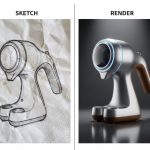
We are transitioning from a manual modeling workflow to a “Prompt-to-Product” ecosystem. In this new era, the AI doesn’t just assist the designer—it acts as the designer. By leveraging vast databases of mechanical engineering principles and material science, AI removes the technical friction of CAD.
The Shift from CAD to Conversation
Imagine a workflow where a user speaks directly to the machine:
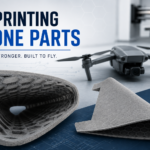
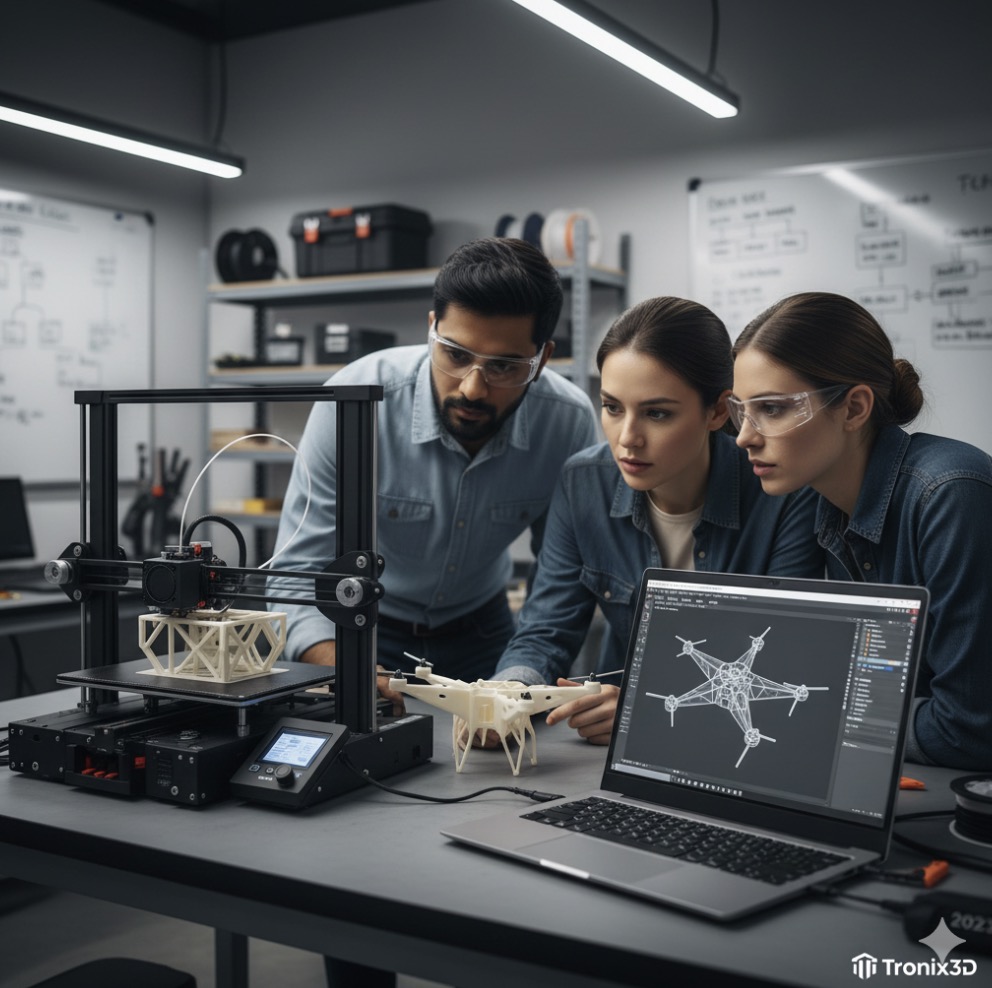
“Design a high-strength quadcopter arm optimized for vibration dampening and weight reduction, compatible with a 2207 brushless motor.”
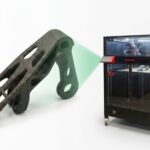
Within seconds, the AI generates a print-ready, topologically optimized model. It understands the specific tolerances of the filament being used. It calculates the necessary infill density for structural integrity. It turns a sentence into a physical solution. This is the moment 3D printing evolves from a hobbyist’s tool into a creative superpower.
Unleashing Mass Customization through Generative Design
In traditional manufacturing, “custom” means “expensive.” Tooling costs and assembly line configurations make unique items prohibitively costly.
AI-driven 3D printing flips the economics of manufacturing. Because an AI can iterate on a model instantly, every single print can be tailored to a specific individual’s needs without increasing design overhead.
- Aerospace & Robotics: Lightweight, organic structures generated by AI that are impossible to model manually.
- Ergonomics: Tools and interfaces shaped perfectly to the unique biometrics of the end-user.
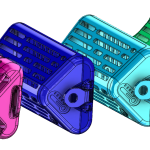
- Sustainability: Generative design uses only the material required for strength, drastically reducing waste in the production cycle.
2026: The Year the Factory Becomes Intelligent
At Tronix3D, our mission is to ensure that a brilliant idea is never held hostage by a steep learning curve. The synergy of AI and additive manufacturing represents the true maturation of our industry.
We are moving past the “Photocopier Era” and into a future of Creative Manufacturing. In this new world, you no longer buy what is available; you prompt exactly what you need.
The hardware is ready. Now, thanks to AI, the architect is finally inside the machine.