In today’s manufacturing landscape, engineers are tasked with meeting aggressive timelines while balancing cost efficiency and sustainability. Additive manufacturing technologies like HP Multi Jet Fusion and Cold Metal Fusion are making this possible by combining agile production, digital design, and batch optimization. Together, these practices not only streamline production but also deliver measurable environmental and economic benefits.
Agile Production: Manufacturing at the Speed of Demand
Traditional manufacturing often relies on large batch sizes, tooling, and long lead times. Agile production changes the equation by enabling parts to be produced just-in-time with minimal setup. This flexibility reduces the need for warehousing, cuts down on overproduction, and shortens development cycles.
For example, Tronix3D leverages rapid prototyping and short-run production to help aerospace and defense customers move from concept to deployment in days, not months. The result: faster innovation, reduced risk, and lower total production costs.
Digital Design: Optimizing for Function and Sustainability
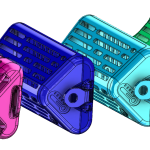
At the core of additive manufacturing is the digital design process. Engineers can redesign components for lightweighting, part consolidation, and optimized strength-to-weight ratios, all while reducing material usage. Unlike subtractive methods that generate significant waste, digital-first workflows ensure that material is placed only where it’s needed.
This approach is particularly effective in aerospace and robotics applications, where weight savings directly translate into improved fuel efficiency and reduced emissions. By aligning design for additive manufacturing (DfAM) with performance requirements, companies achieve both environmental responsibility and cost savings.
Batch Optimization: Efficiency Without Compromise
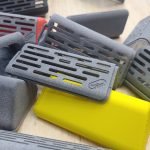
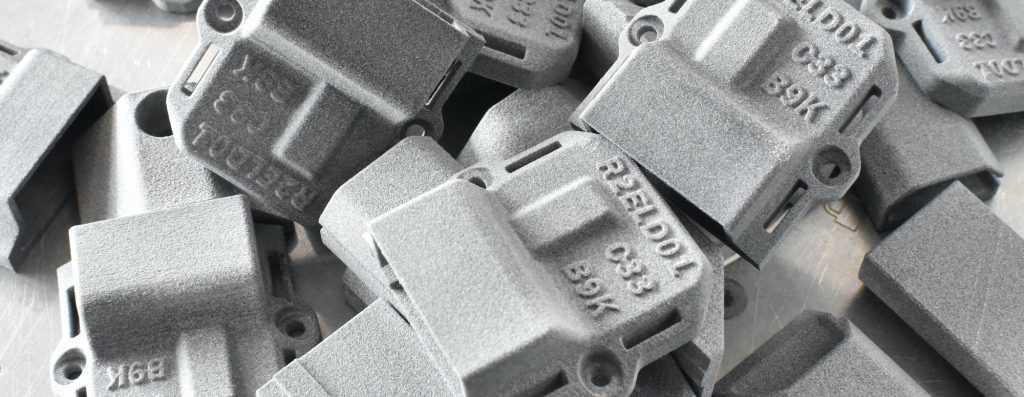
Batch optimization is about producing more with less. In processes like HP Multi Jet Fusion, thousands of unique parts can be nested and printed simultaneously. This maximizes build density, reduces energy consumption per part, and ensures consistent quality across the entire batch.
For industries requiring high-mix, low-volume parts, such as medical devices or defense systems, batch optimization makes additive manufacturing both economically viable and environmentally efficient.
Environmental and Economic Outcomes
When combined, agile production, digital design, and batch optimization deliver powerful outcomes:
- Reduced Waste: Additive processes minimize scrap compared to machining and molding.
- Lower Inventory Costs: On-demand production cuts warehousing needs.
- Energy Efficiency: Optimized builds consume less power per part.
- Sustainability Initiatives: Programs like Stratasys’s ReLife, where Tronix3D is a beta partner, further close the loop on polymer use.
- Faster ROI: Shorter development cycles and leaner supply chains lower the cost of innovation.
Conclusion
The future of manufacturing lies in flexible, digitally driven production models. By integrating agile production, digital design, and batch optimization, engineers can achieve the dual goals of economic performance and environmental stewardship. For industries from aerospace to medical, this approach is proving that sustainable manufacturing is not only possible, it’s profitable.
Ready to take the next step?
Partner with Tronix3D to streamline your supply chain, accelerate product development, and reduce environmental impact with advanced additive manufacturing solutions. Contact us today to start your next project.